Sticking stuff in the cloud is the popular answer to everything these days, and I just see the cloud as the new mainframe. It’s not a solution so much as a different take on the same problem, and while I see a couple of potential disadvantages, believe it or not I see some real advantages to the approach as well.
I see people asking about the difference between the TP-Link TL-WR841N and TL-WR841ND (sometimes they just ask TP-Link TL-WR841N vs TL-WR841ND). Since nobody else seems to have answered, I’ll take the question.
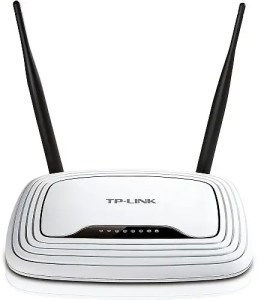
This is the TP-Link TL-WR841n.
Here’s how to decode TP-Link model numbers. This is true of the 841 series, which is my go-to for the moment when I need a capable yet inexpensive router, but also other TP-Link models.
“TL” stands for TP-Link. “WR” stands for wireless router. The numbers tell you where the model stands in the product line. Beefier routers have larger numbers. “N” stands for the type of networking, which, in this case, is 802.11N. “D” stands for detachable antennae.
If you don’t need to be able to detach the antennae to replace them with bigger, longer-range models, you can save some money by buying the N-model. Otherwise, the TL-WR841N and TL-WR841ND are functionally identical. They both use the same DD-WRT build.
I’m not particularly worried about this, but under the very worst case scenario, certain solid-state disks can theoretically lose data in a week or two if they’re left without power. But that doesn’t instill panic and get clicks when you say it like that.
But you knew I was going to write about it. Let me tell you why I’m not worried.
Last week, at about 238,000 miles, we traded my wife’s 2002 Honda Civic. It was good to us.
She drove that car the night we first met. It was the car we drove home after we got married. We drove our dog home from the Humane Society in it, I drove her to the hospital in it, and we drove our two boys home from the hospital in it. When a car lasts 13 years, it gets to participate in a lot I guess.
There are a few hucksters on Ebay, whom I don’t care to give free advertising by mentioning by name, who hawk “graded” cards on Ebay and claim them to be especially valuable. One even puts supposed appraised values in his listings in parenthesis, then invites you to visit his page for an explanation of “graded” value, where he cites an example of a run-of-the-mill 1970s star card, normally worth $60, being worth $2,500 once graded.
The thing is, that’s an edge case. It’s important to understand those edge cases to avoid a ripoff.
One of my peers–he does exactly what I do at work, but for Unix machines while I cover Windows–asked me for some tips for giving presentations after he gave a presentation last week. I’ve presented a couple of times myself, and from the feedback I received, I didn’t make too much of a fool of myself, so he asked for my feedback.
I gave him a few tips that have served me well over the years.
So I understand ISPs are upselling connection speeds saying it’ll make Netflix work better. That’s a nice theory. But if you’re already over 10 megabits, there’s a decent chance your connection speed won’t do much for Netflix at all. Here’s how to size your Internet connection. Read more
Most modern cell phones have an FM radio built into their SoC, but the only major makers who are actually enabling them are HTC and Motorola. There’s disagreement over whether this is a problem, of course.
My Moto E has an FM radio and an app that lets me use it. I have to say if I’ve used it, I don’t remember it. But as NPR says, there’s an advantage to it.
To provide the best experiences, we use technologies like cookies to store and/or access device information. Consenting to these technologies will allow us to process data such as browsing behavior or unique IDs on this site. Not consenting or withdrawing consent, may adversely affect certain features and functions.
Functional Always active
The technical storage or access is strictly necessary for the legitimate purpose of enabling the use of a specific service explicitly requested by the subscriber or user, or for the sole purpose of carrying out the transmission of a communication over an electronic communications network.
Preferences
The technical storage or access is necessary for the legitimate purpose of storing preferences that are not requested by the subscriber or user.
Statistics
The technical storage or access that is used exclusively for statistical purposes.The technical storage or access that is used exclusively for anonymous statistical purposes. Without a subpoena, voluntary compliance on the part of your Internet Service Provider, or additional records from a third party, information stored or retrieved for this purpose alone cannot usually be used to identify you.
Marketing
The technical storage or access is required to create user profiles to send advertising, or to track the user on a website or across several websites for similar marketing purposes.